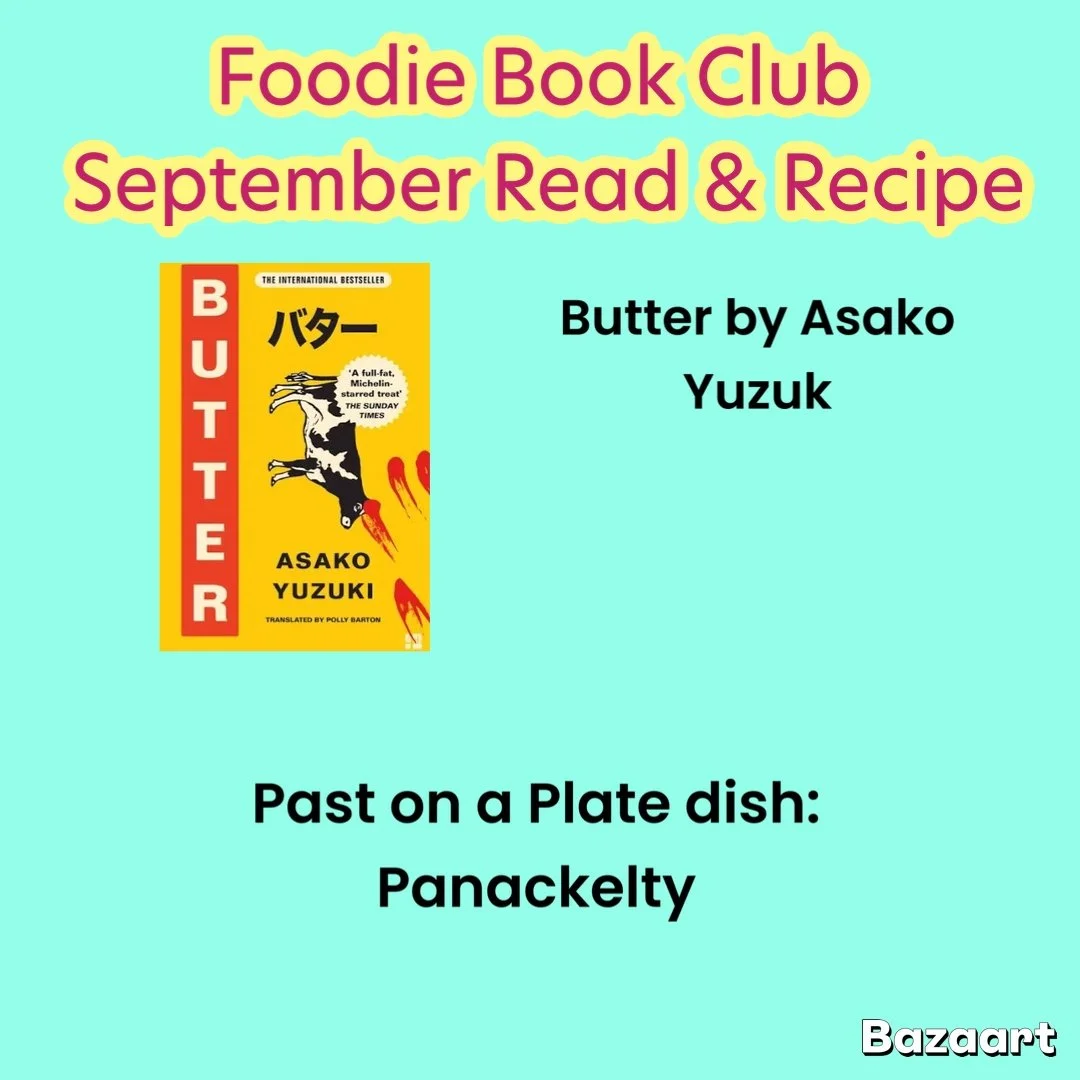
Butter by Asako Yuzuki & Past on a Plate Recipe
Author:
Asako Yuzuki isn’t your average contemporary novelist.
Born in Tokyo in 1981, she has quietly become one of Japan's most celebrated literary voices, best known globally for her sensational, mouth-watering breakout novel, Butter.
Her specialty? Crafting stories that dissect the dizzying pressures of modern womanhood, psychological obsessions, and—crucially—our complex relationships with food.
But to understand how she weaves such rich tales, you have to look at a childhood that was equal parts daydreaming, cosy rebellion, and a healthy dose of Western carbs.
Growing up as an only child in Tokyo, Yuzuki was raised by a standard corporate "salaryman" father and a mother in the clothing industry who happened to have a background in oil painting.
It was her mother who gave her the best piece of life advice early on: never look at starting over as a waste of time, and always embrace change.
As a kid, Yuzuki was a total chatterbox with a massive imagination.
She tore through Western children’s classics like Pippi Longstocking, Anne of Green Gables, and Beverly Cleary's Ramona books. Oddly enough, it wasn't just the adventures that hooked her; it was the food.
Descriptions of foreign delicacies like warm pies and apple preserves—things that felt entirely alien in Japan at the time—completely fascinated her.
Her literary trajectory shifted dramatically in junior high when a severe bout of mycoplasma pneumonia left her completely bedridden. Stuck in bed, she picked up Banana Yoshimoto’s iconic novel Kitchen. It was a total lightning-bolt moment, instantly sparking a deep obsession with native Japanese fiction.
Yuzuki wasn't exactly a cookie-cutter student. In fact, she "stood out" so much in primary school that an observant first-grade teacher gently suggested her parents look into a more liberal, open-minded environment for her.
This led her to Keisen Jogakuin, a private, progressive all-girls junior and senior high school.
Far from a rigid academy, the school favoured lively public debates and even let students run their own agricultural markets—an unconventional upbringing that heavily shaped her worldview. She eventually levelled up her love for books at Rikkyo University, graduating with a degree in French Literature after tackling a senior thesis on the 19th-century realist mastermind, Honoré de Balzac.
Before she was an award-winning novelist, Yuzuki spent years navigating a gloriously chaotic career path. Armed with a dream of writing for the screen, she attended Tokyo's famous Scenario Centre and worked a stint as a plot writer for television dramas.
Then came her foray into corporate Japan at a famous confectionery company.
It turns out that thinking up 100 different concepts for candies and snacks under extreme high pressure is excellent mental conditioning for a future writer—and it certainly didn't hurt her lifelong food fixation!
To keep the lights on while writing her early fiction on the side, she juggled everything from working as a cram school (juku) instructor to grinding away as a contract office clerk.
Her relentless multi-tasking finally paid off in 2008 when she won the prestigious All Yomimono Prize for New Writers, officially launching her career as a full-time author.

Asako Yuzuki
Book
Originally published in Japan in 2017 and brilliantly translated into English by Polly Barton, this cult international bestseller mix of social satire, feminist critique, and psychological thriller.
The plot kicks off with an incredibly bizarre, symbiotic dynamic between two women:
The Gourmet Serial Killer: Manako Kajii is a notorious woman locked away in a Tokyo detention centre.
She has been convicted of the serial murders of several wealthy, lonely businessmen whom she allegedly seduced with her magnificent, calorie-dense cooking before poisoning them.
The media is utterly fixated on her—not just because of her crimes, but because she is an unapologetically plus-sized woman who refuses to feel guilty about enjoying food, completely breaking the stereotype of the youthful, slender femme fatale.
Rika Machida is a lonely, highly stressed magazine reporter who happens to be the only woman in her rigid newsroom.
Rika’s personal life is a mess of exhaustion, terrible convenience-store meals, and a deeply toxic, constant anxiety about her weight and body image.
Kajii has completely frozen out the press. Knowing the killer’s culinary obsession, Rika writes her a letter completely bypassing the murders and instead asks for Kajii’s elite recipe for beef stew.
Hooked by the gourmet flattery, Kajii agrees to speak to her under one strict condition: they will only talk about cooking.
From the moment Kajii tells Rika that she cannot tolerate two things—"feminists and margarine"—she pushes the young journalist to abandon "fake" low-fat diets and consume real, decadent butter.
As Rika dives headfirst into luxurious recipes, her body, her relationship with herself, and her entire life begin to shift in unexpected, dangerous ways.
The chilling premise isn't entirely fiction.
Yuzuki based the book on the infamous 2009 real-life case of Kanae Kijima, dubbed the "Konkatsu Killer" (marriage-hunting killer).
Kijima was convicted and sentenced to death for poisoning three men she met on dating websites.
Just like the character in the book, Kijima was a highly trained gourmet cook who ran a popular culinary blog, and the Japanese media faced severe backlash for its intensely fatphobic, cruel obsession with her physical appearance during the trial.
To ensure absolute authenticity while writing the book, Yuzuki went so far as to sign up for the exact same high-class Tokyo culinary academy that Kijima had attended.
The book became a massive global sensation, selling nearly 1.5 million copies worldwide and proving that readers everywhere have a massive appetite for smart, subversive feminist fiction.
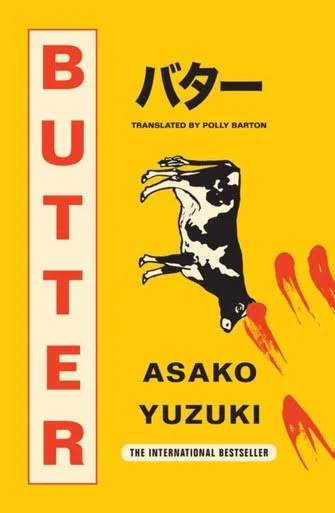
Butter by Asako Yuzuki
My Thoughts
I didn't want to love this book, but I absolutely did—right off the bat.
It has introduced me to another incredibly talented author to add to my growing reading list.
At its core, Butter uses vivid, rich descriptions of food—like hot soy sauce rice melting over a slab of butter—as a brilliant metaphor for female autonomy.
Yuzuki holds up a mirror to the impossible, exhausting standards placed on modern women. We are expected to stay effortlessly thin and submissive, while simultaneously keeping up with a demanding corporate world.
For my generation, it was deeply refreshing to see these unspoken realities put into words. It perfectly captures what many of us have been taught our entire lives: to be small in our bodies, our voices, and our presence, while somehow being the ones who hold the entire world together. It is an immense amount of pressure from a society built by men, for men.
The character development is excellent.
Over time, we see Rika Machida’s sense of identity shift once she begins visiting the "killer," Manako Kajii, in jail.
As Rika starts cooking and eating food she actually enjoys, her body changes, her appreciation for food grows, and she develops a much deeper understanding of herself.
The book pairs insight into the pure pleasure of food with a descriptive vocabulary that brings every dish to life.
Alongside these vivid settings, the characters are remarkably strong. Each one is as rich as the dishes themselves, with believable backstories that unfold like complex flavours.
I give this book a worthy 5 egg rating.
Let me know your thoughts on it.
5 egg Rating
Past on a Plate
This month, alongside all the usual book updates, I’m launching a new feature: a monthly look at the history behind some of our favourite dishes, complete with the recipes themselves. I really hope you have as much fun reading and cooking these as I do researching them!
First up on the menu is Panackelty.
If you aren't from the Northeast of England—specifically around Sunderland or County Durham—you might not have a clue what this is (or how to spell it, since locals argue between panaculty, panacalty, or pankelty!).
At its heart, it’s a traditional, slow-cooked comfort casserole born out of working-class necessity. It's deeply woven into the region's old mining and shipbuilding heritage.
Back in the 19th and early 20th centuries, families needed cheap, filling ways to feed manual labourers. Panackelty was the perfect frugal hack. Housewives would gather up whatever root veg they had on hand, throw in leftovers from the Sunday roast (usually lamb or beef), and pack the dish with extra potatoes to stretch it further.
It was the ultimate "all-day" slow cook.
A big pot would sit on the side of a coal-fired range all day while women tackled gruelling housework. By the time the men walked through the door from freezing shifts at the shipyards or pits, a hot, calorie-dense meal was waiting to warm them up.
There’s even local folklore that says it was served as a vital, sustaining fuel for the famous Jarrow Marchers in 1936.
As for the name? It literally comes from the "pan" it's cooked in.
Local dialect experts suggest the second part comes from the old word kilt, which meant to gather or tuck up—making the dish a literal "gather-up of leftovers in a pan."
While exact family recipes varied depending on the budget that week, the basics stayed the same:
· The Meat: Traditionally Sunday scraps, though tinned corned beef, bacon, or local sausages became the standard as time went on.
· The Veg: Plenty of thinly sliced potatoes, onions, and root veggies like carrots or turnips.
· The Build: Everything gets layered up with a rich beef stock and baked until the potatoes on top get tender and beautifully browned.
To top it all off, it's traditionally served with a Stottie cake—a heavy, flat North Eastern bread that is absolutely perfect for mopping up every last drop of gravy.
Recipe
Here is a traditional, authentic Wearside-style panackelty recipe passed down through generations of Northeast families.
This version uses tinned corned beef, which became the standard during the mid-20th century for its convenience and rich flavour.
This recipe is by Lavender & Lovage by Karen Burns -Booth. Heres the link to the website so you can enjoy more of her recipes:
Ingredients
4 x large potatoes, peeled and sliced very thinly
2 onions, peeled and sliced very thinly
1 x 340g tin corned beef, sliced thinly
1 x OXO cube, dissolved with 150ml hot water
White pepper, to taste
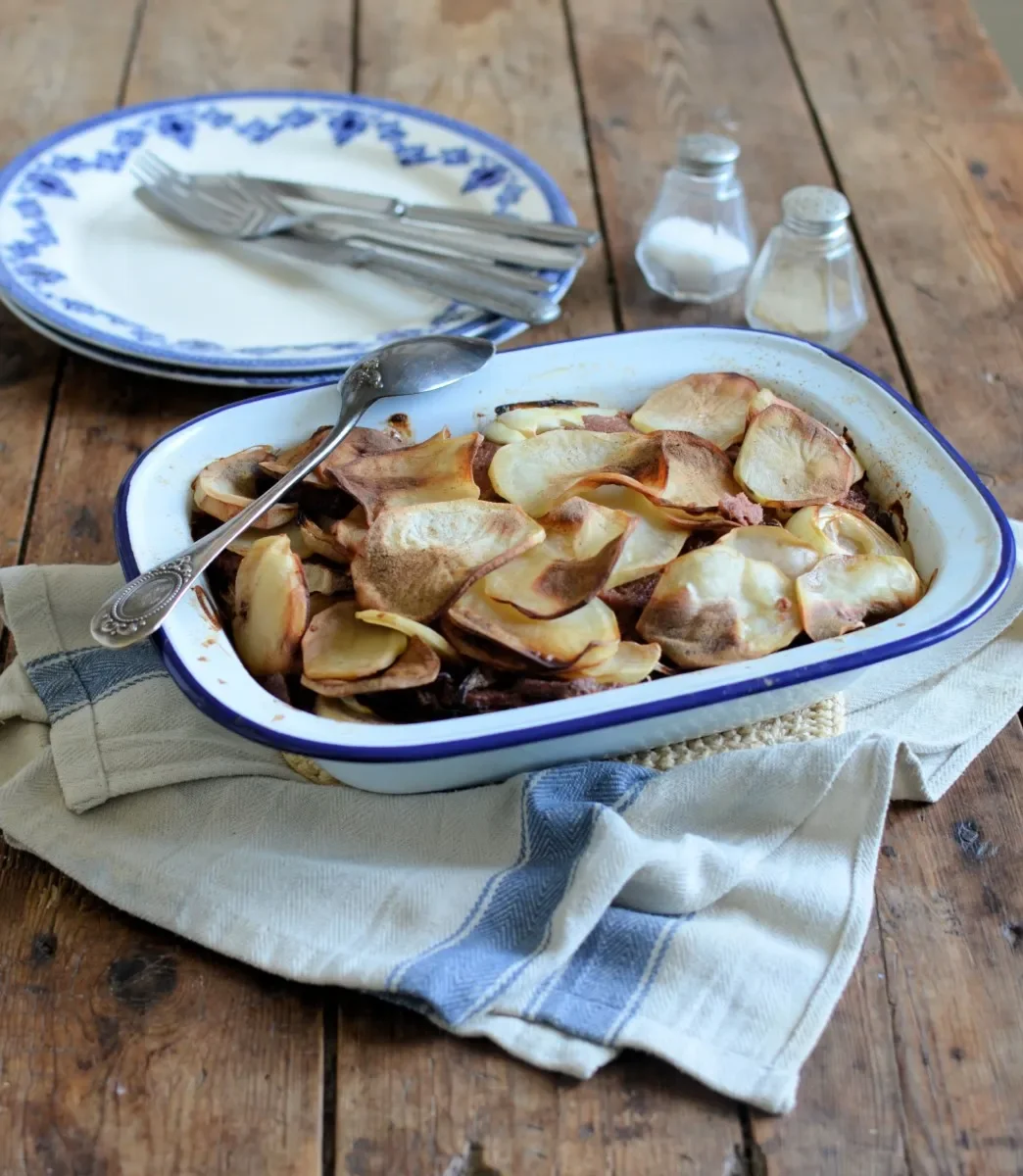
Photo by Lavender & Lovage:
Instructions
Pre-heat oven to 180C/350F/Gas mark 4.
Layer sliced potatoes, sliced onions and the corned beef slices in an ovenproof dish, finishing with a top layer of potatoes, seasoning with pepper between each layer. (My grandma used an old oval enamel dish). Pour over the oxo stock and cover with a lid or foil.
Cook in the pre-heated oven for an hour, removing the lid/foil for the last quarter of an hour, continue baking until the potatoes are browned and cooked.
Serve hot with fresh green vegetables, such as Savoy cabbage.