Parsley Rough Puff Pastry
Sometimes i just need to add as much flavour as i possibly can and when i do, i make a flavoured pastry. This rough puff is the perfect vehicle to add dried herbs and seasoning, so parsley is a taste that i add a lot. It goes with so many things.
I think too many people are afraid of making puff pastry, and i can see why that would be. It does sound complicated, all that layering and laminating.
Not so with this recipe.
As a general rule, as long as the pastry doesn’t get kneaded ( as with bread dough) and through all of the processes , you can still see bits of butter in the dough, ther shou;dnt be any proble.
When the heat hits the pastry, steam will be formed and this steam causes pockets of air resulting in layered rise.
Easy right!
Try it for my Goat Cheese, Date & Walnut Tart with Hot Honey.
Go on, give it a go and enjoy your sweet life!
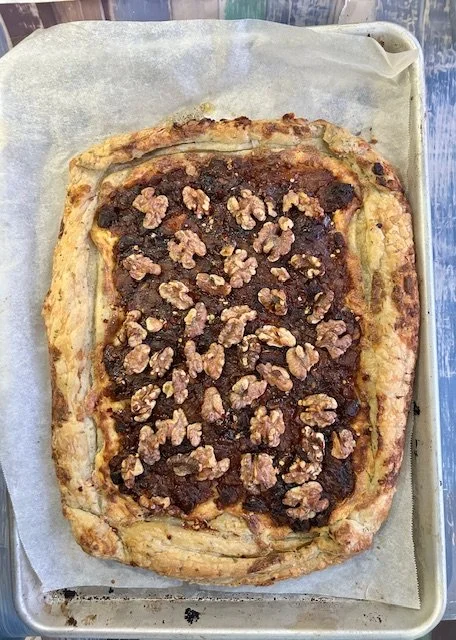
Perfect layers in this Goat Cheese, Date & Walnut Tart with Hot Honey
What You Need
250g Strong White Flour
250g Salted Butter – Cold & cut into small chunks
2 tbsp Dried Parsley
150 ml Cold Water Approx. – See Tip Box
½ tsp Salt
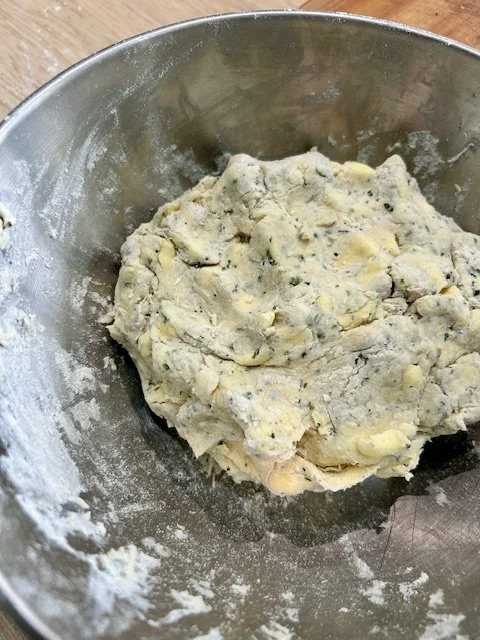
Do NOT knead the dough
How It’s Done
Place the flour, parsley and salt into a bowl and mix it all together.
Put int the cold chopped butter and either use your fingertips (or a pastry cutting tool) to rub in the butter until the pieces are smaller and still visible.
Make a well in the centre of the and add about half of the cold water
Use a blunt knife to mix it together, before bringing it together with hands.
Slowly add more water if needed
The dough should be soft but not wet.
It’s important not to over work the dough and only just bring it together without kneading it. – See Tip Box
It should be possible to see the chunks of butter in the pastry.
Leave the pastry in the bowl, place a piece of non- stick baking parchment on top of the dough and let it rest in the fridge for around 2- minutes – See Tip Box
After its rested, add just a little flour onto a clean work surface and roll out the dough into a rectangle (about 12’ by 6’) – use as few rolls as possible to do this, the butter should still be visible at all times.
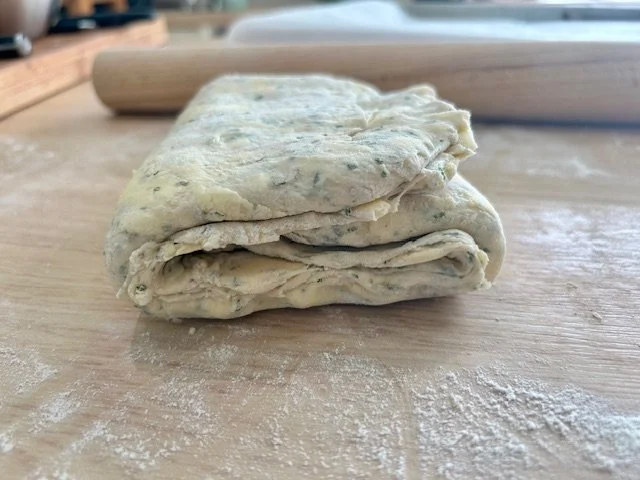
Fold the bottom third of the pastry up to the middle and the top third of the pastry over the bottom fold.
Repeat another two times and then wrap the pastry in cling film and let it rest in the fridge once more for at least 30 minutes.

Bottom third up
Tip Box
How Much Cold Water – How much water needed is approximate
DO NOT knead the pastry – Pastry dough is not like bread dough it does not need to be kneaded.
Kneading pasty makes it tough to eat and in the case of rough puff, it will only melt the butter and it’s the butter which males the rise when it hits the heat.
Covering the dough – Covering the dough when resting stops a crust forming on the surface. I use either cling film, non-stick baking parchment, or the paper used for the butter.
Seeing the butter in the pastry – This is very important. It’s the butter within the pastry which once it hits the heat of the oven, will make the pastry rise and cause those lovely layers expected with rough puff pastry.
A tip to keep the pieces of butter is to only roll the pastry one way not back and froward