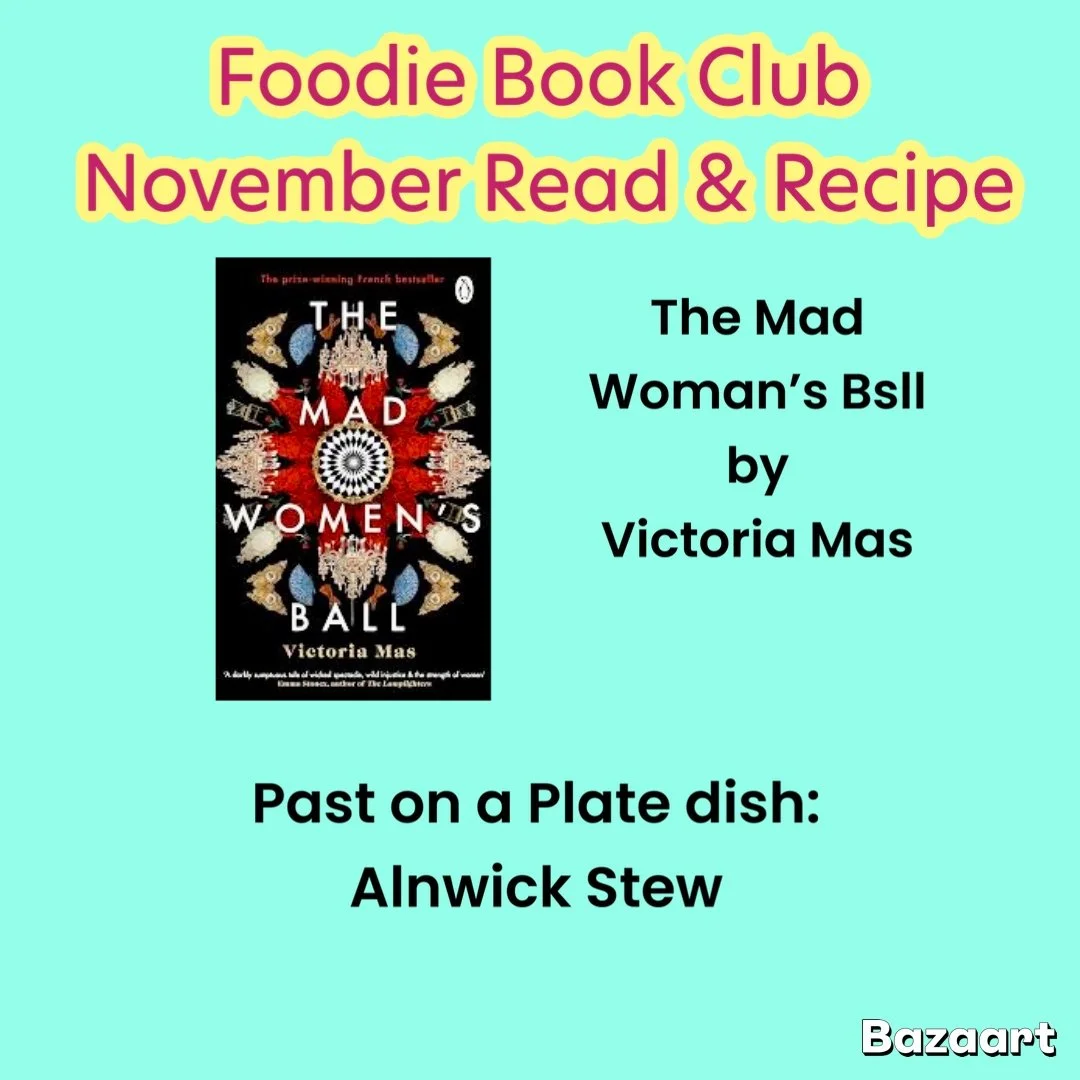
The Mad Woman’s Ball by Victoria Mas - Past on a Plate Recipe by Pies, Puddings and Pottages website.
Author
Victoria Mas is the French author who looked at 19th-century medical misogyny and thought, “Yes, there is a bestseller in this.” Despite her meteoric rise in the literary world, her path to becoming a novelist was anything but traditional.
Born in 1987, Mas didn't exactly grow up in obscurity. Her mother is Jeanne Mas, an iconic French pop star who dominated the 1980s music charts (most famously with the hit single "En Rouge et Noir").
Despite her mother’s massive fame, Victoria’s childhood was surprisingly quiet. She spent her early years with her mother and her younger brother, Christopher, growing up in a small, sleepy village called Rognes in the South of France. Instead of a flashy showbiz upbringing, she recalls spending most of her childhood quietly reading in the family garden.
While her mother provided the musical genes, it was her father who steered her toward literature. Her father, who works as a private tutor, was incredibly strict about proper grammar and composition. He actively helped her hone her writing skills from a young age, turning language into a shared bond rather than just a school subject
Mas spent eight years living in the United States alongside her mother and brother. She moved to California for her studies, but as a self-described "introvert," she found the American lifestyle a bit of an awkward fit
While in the US, she cut her teeth in the film industry, working a variety of demanding behind-the-scenes jobs:
Eventually, homesick for the streets and the rhythm of the French language, she packed her bags and moved back to Paris. She enrolled at the Sorbonne University, where she earned her Master’s degree in Contemporary Literature, effectively bridging her cinematic background with her love for books.
When it comes to her private life, Mas keeps her cards incredibly close to her chest. She is fiercely protective of her privacy and deliberately avoids the celebrity gossip mill.
She has not publicly disclosed whether she is married or single, nor has she shared details about having children, preferring to keep the spotlight strictly on her work.
Beyond her obvious love for reading, she remains passionate about photography—a hangover from her cinema days—and loves exploring the historical architecture of Paris
The Madwomans Ball (2019) Her blockbuster debut novel set inside Paris’s notorious Salpêtrière Asylum under the celebrity neurologist Dr Jean-Martin Charcot. It exposes how 19th-century men used the guise of "hysteria" to lock away inconvenient women. The book won major accolades like the Prix Stanislas and was adapted into a film by Mélanie Laurent
The Island of Mists and Miracles (2022) Her follow-up novel, which moves away from the asylum to a windswept, isolated island, focusing on human isolation, community, and faith.

Victoria Mas
Book
The Mad Women's Ball is a razor-sharp critique of 19th-century medical misogyny, masquerading as a Gothic historical thriller.
The story takes place in 1885 inside the grim walls of Paris’s notorious Salpêtrière Asylum.
The institution is spearheaded by the celebrity neurologist Dr Jean-Martin Charcot, a man who has turned the diagnosis of female "hysteria" into a public spectacle.
Every week, the Parisian elite pack into an auditorium to watch Charcot hypnotise vulnerable women for their voyeuristic entertainment.
The narrative heads toward the climax of the asylum's calendar: the annual "Bal des folles" (the Mad Women's Ball). This is a real historical event where the cream of Parisian high society dresses up, drinks champagne, and rubs shoulders with the asylum patients as if they are exhibits at a human zoo.
Through the intersecting lives of a rebellious young bourgeois woman, a grieving head nurse, and a long-term patient, the book exposes a dark reality. Most of the women locked inside the Salpêtrière are not actually mad; they are just inconvenient. They are headstrong daughters, unwanted wives, victims of male trauma, and independent women who have been swept under the rug by a society that demands absolute female submission.
At the absolute top of this medical hierarchy sits Dr Jean-Martin Charcot, a brilliant but deeply arrogant medical god who rules the asylum like a personal theatre.
To him, the women under his care are not human beings to be cured, but clinical specimens to be staged.
His star exhibit is Louise, a young teenager traumatised by horrific sexual abuse whose subsequent seizures are conveniently misdiagnosed as classic "hysteria." She is Charcot’s favourite patient for public hypnosis demonstrations, naively pinning all her hopes on the upcoming costume ball in the belief that a young doctor is in love with her and will rescue her from the ward.
Managing the daily reality of these women is Geneviève, the stern, long-serving head nurse. Entirely devoted to science, logic, and the genius of Charcot, Geneviève runs the ward with clinical efficiency—until her world is completely upended by the arrival of Eugénie Cléry.
Eugénie is a fiercely independent 19-year-old from a wealthy bourgeois family who possesses the secret ability to communicate with the dead.
After her tyrannical father discovers this inconvenient truth, he promptly dumps her at the asylum to protect the family’s social standing.
Rational and defiant, Eugénie refuses to be broken by the institution. Instead, by revealing secrets about Geneviève’s deceased sister that no one else could possibly know, she cracks the nurse’s rigid faith in medical authority, forcing a quiet revolution between the two women as the night of the ball approaches.
This months book and recipe
My Thoughts
This was an easy book to get into.
It struck a cord with me because of the open level of misogyny, having experienced so much in my younger days, the history of which is something I’ve been thinking about more in depth lately.
The setting of the book is one I found fascinating, and the way the author pulled on real people and events added to the depth of the characters and added to the horror of what happened to women in the book and at that time in history.
It felt as though the author had been affected by her research into the history of the hospital and this resonated onto the pages of her book. with her emotions being transferred to the primary characters.
Having never come across this author before, I would certainly look out for more of her books.
I give it a 4 egg rating

I give it a 4 egg rating
Recipe
The second recipe from my featured Past in a Plate: a monthly look at the history behind some of our favourite national dishes, complete with the recipes themselves taken from some great independent food content creators I follow or just came across while I’m trawling through the internet.
This month is Alnwick Stew, a traditional Northumberland one-pot dish that slowly cooks layers of gammon, onions and potatoes into a rich, comforting meal.
Closely associated with the historic market town of Alnwick, the recipe is thought to have originated at Alnwick Castle, home of the Percy family, Dukes of Northumberland.
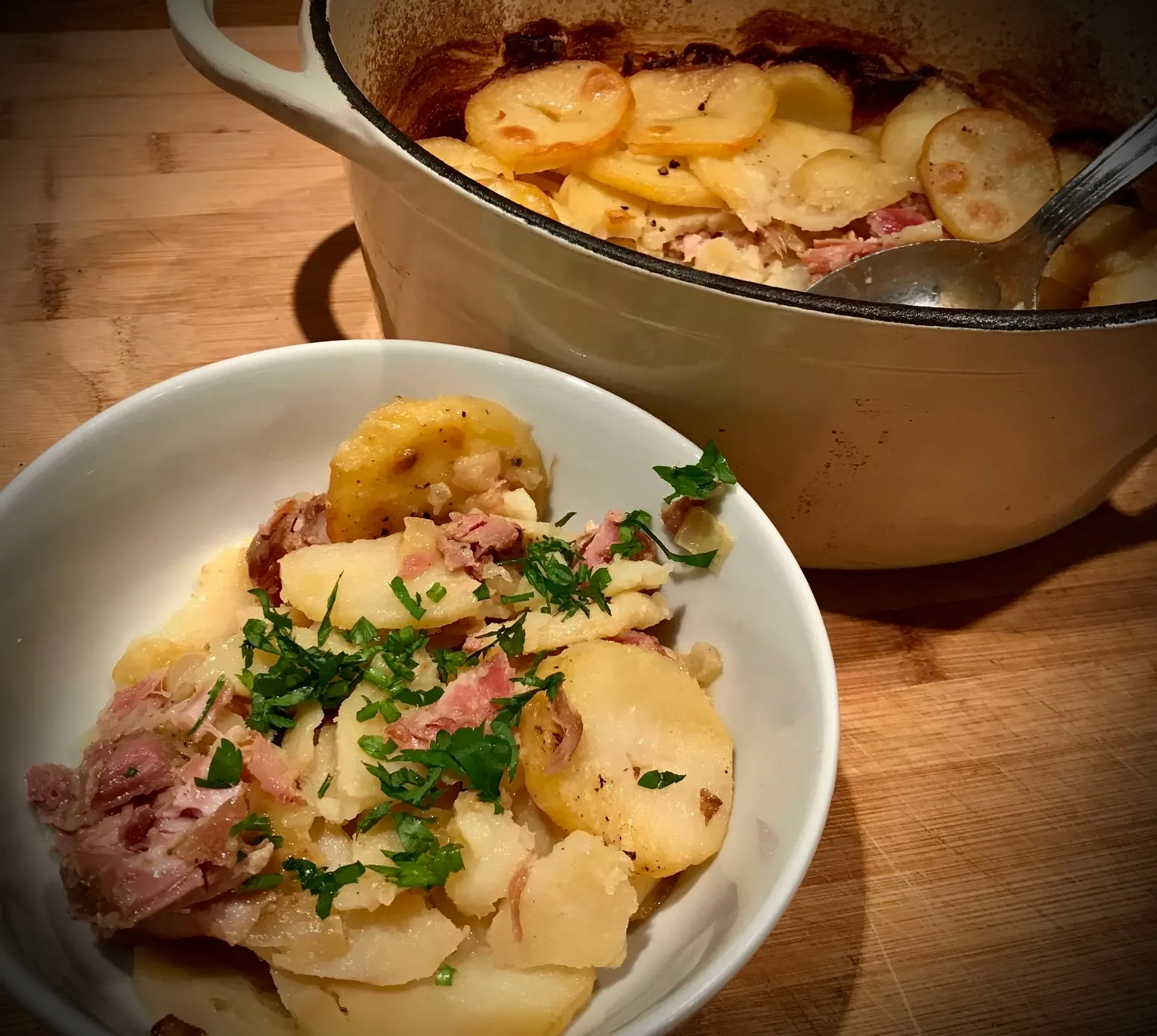
Alnwick Stew, Photo taken from Pies, Puddings & Pottages website.
History
While the dish is firmly rooted in the northern English tradition of topping meat stews with a layer of potatoes, its formal history is closely tied to Alnwick Castle, the historic seat of the Percy family (the Dukes of Northumberland)
The stew became widely recognised in the 1920s as a favourite dish of Lord Ian Percy of Alnwick Castle. Because of this high-profile appreciation, it became a signature menu item at the famous White Swan pub in the market town of Alnwick.
Despite its popularity among the local nobility, food historians note that the recipe's true origins are "hazy" and likely pre-date its 20th-century commercial prominence.
The White Swan pub almost certainly adopted the recipe from local Alnwick housewives who had been cooking variations of the layered dish for generations
Northumberland culinary traditions heavily feature preserved pork like gammon, thick-cut cooking bacon, or ham hocks. The stew was designed as a "frugal meal" to stretch inexpensive cuts of salty meat by layering them with cheap, filling staples like onions and sliced potatoes.
Alnwick stew belongs to a broader family of layered, slow-cooked North East English comfort foods. It’s structurally very similar to Pan Haggerty (or Panacalty), another iconic Geordie/Northumbrian dish that relies on the magic of layering potatoes, onions, and cheese or meat into a heavy baking dish or skillet.
Unlike many modern stews where ingredients are tossed together in a loose gravy, a true historic Alnwick stew is explicitly assembled in strict, seasoned layers (often with a hint of English mustard powder) and cooked with just enough stock to steam the ingredients until the top layer of potatoes turns beautifully golden and crisp.
Found on the Pies, Puddings and Pottages website.
https://piespuddingsandpottages.com/recipe-post/426/
Ingredients
1 smoked ham hock weighing (about 750g)
1 large onion, peeled and cut in half
2 carrots, roughly chopped
2 celery stalks, deveined and roughly chopped
1 bay leaf
Sprig of thyme
3 onions, peeled and chopped
Oil
25 g butter
2 tsp dry English mustard
4 large waxy potatoes, peeled and cut into slices about the thickness of a £1 coin
1 litre hot vegetable stock
Handful flat-leafed parsley
Method
Cut the rind and excess fat off the ham hock and place in a large-lidded saucepan.
Cover with cold water and add the onion, carrots, celery, bay leaf and thyme.
Bring to the boil and simmer for 2 to 3 hours, skimming off any scum that rises to the surface.
When the ham hock is tender and falling off the bone, turn the heat off and allow to cool a little before removing the ham hock onto a chopping board.
Remove the meat from the bones and chop into bitesize chunks. Place in the bowl and set aside.
Preheat the oven to 180C/350F/gas 4.
Heat a little oil in the frying pan and sauté the onions on a moderate heat until translucent. Remove from the heat and set aside.
Melt the butter in the casserole.
Put half the onions in the bottom of the casserole and season with black pepper and a little mustard powder.
Layer half the ham hock meat on top, seasoning again, then top with half the potatoes.
Repeat this layering once more.
Pour in enough stock to reach just below the top layer of potatoes.
Bring to the boil, cover with the lid and place in the oven for an hour.
Remove the lid and bake for a further 30 minutes to brown the top layer of potatoes.
Sprinkle with chopped parsley and serve.